Holy Myrrhbearers Monastery
What does it mean to be an American Orthodox Monastery? Q&A with Mother Raphaela
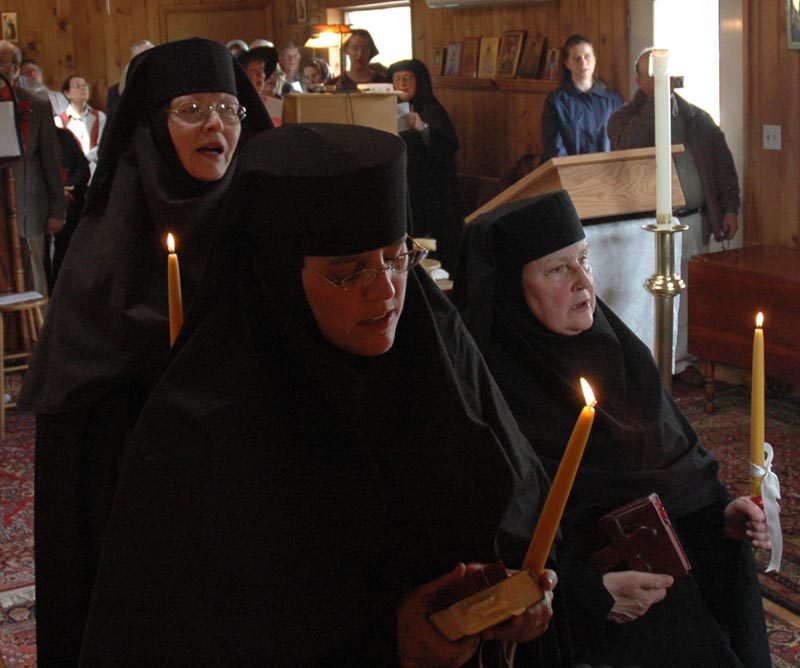
Our postulant sat down with our abbess to ask about principles behind the founding of Holy
Myrrhbearers Monastery almost 50 years ago
Postulant: You’ve said that we're not trying to to copy Russian or Greek monasticism. We want
to be an American monastery. What does that mean to you, an American monastery?
Abbess: Well, that means finding our own way, our own customs, looking at the American
tradition, and at American places like St. Vladimir’s Orthodox Seminary — of course, that's
where we got our start. We draw on that rather than making trips to Greece and Russia, to try
to bring that back. We're not going to do that. We look at the American Orthodox Church, at its
history, its institutions. But in the basics, it shouldn't make much difference. We should be here
to pray and work out our own salvation. That's the main point of a monastery.
Postulant: For example, we keep the monastic hours, according to the Orthodox Horologian.
But the language? I know you specifically wanted the services to be in English, and not just
English, but …
Abbess: A good colloquial English, yes. Praying in English at all was radical at that time, in the
late 1970s. We were living at the OCA Chancery and they encouraged our work to make a
readable English version of the service books, adapting from other translations.
Postulant: But without “thee” and “thou.”
Abbess: Right. Modern English. It’s hard to pray in a language you don’t understand. Or in a
language you know but still don’t understand. But we don't try to use slang, there's a balance
there.
Postulant: Tell me about the music that we sing in the chapel. It’s from all over, not just Slavic
melodies. There’s Serbian, Bulgarian, Alaskan, even Gregorian chant. How did you put it
together?
Abbess: We visited various monasteries, asked for music, and chose what we liked. Our intent
was always to have music from multiple cultures. We're an American monastery, and that
means drawing from all traditions, not just one. We sing in English, but the music can be from
different countries. And people from different traditions can feel home at home here. For
example, we try to match our response melodies to the background of the serving priest, say,
Carpatho-Russian.
Postulant: And even at our daily Vespers, we sing from multiple traditions. So if we have nuns
here from different backgrounds, they could each hear something familiar.
Abbess: We've inherited a rich tradition, so why narrow it down?
Postulant: And the architecture of buildings? We look like the nearby farmhouses. You didn't try
to build an ornate church with gold domes.
Abbess: No! (laughs) The style of our monastery building is plain. We wanted it to fit in here in
rural Upstate New York. We didn't want it to stand out. If you want that, there are other
monasteries to go to. So we're just trying to fit in and be part of the landscape. That's important
for an American monastery, I think. +